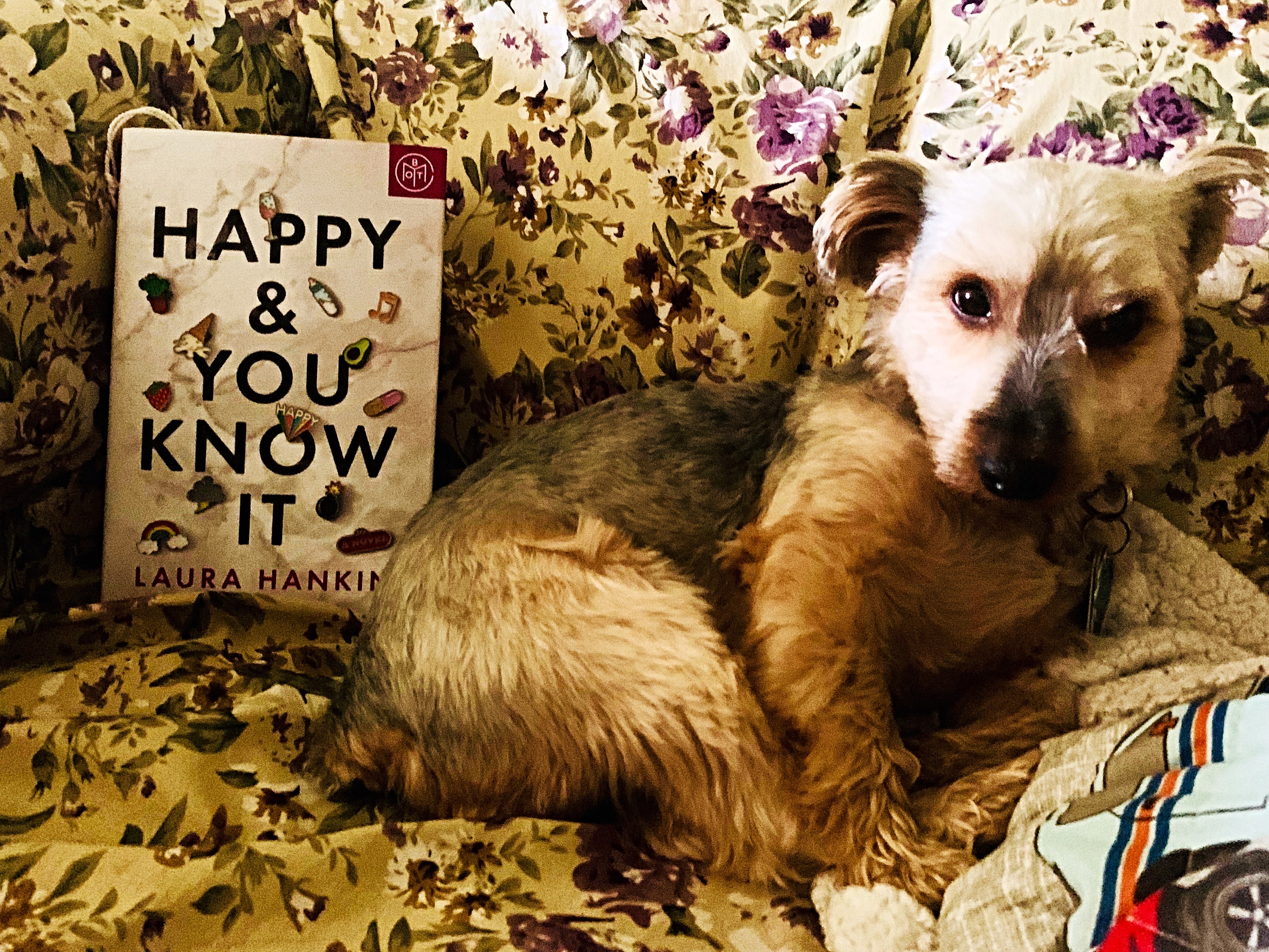
Teddy with the book Happy & You Know It by Laura Hankin
Spoilers below the cut.
A very solid 4 stars. Happy & You Know It by Laura Hankin is a delicious and sometimes shocking novel that I selected as my May Book of the Month. This is one of those books that’s a pure and unadulterated speed read…
No pun intended. (IYKYK).
As I have mentioned previously, I am very much drawn to novels set in New York City because they tap into my nostalgia for the time and place where living there was my dream. I love that I’m still transported to the settings and can visualize in my mind’s eye the buildings where the characters might be sitting, laughing, and dreaming.
I also chose this as my BOTM because, as a 28-year-old woman who also happens to be a millennial, I am approaching that space where I’m seeing via social media a curated version of how the people I grew up with and went to school with are becoming mothers. It’s in all ways as delightful and terrifying as I expected it to be.
My positionality aside, I greatly enjoyed this book. The characters are at times highly identifiable while also incredibly unlikable. I think that’s what makes the book work so well and can sort of be summed up by a Whitney quote from p. 361 of the hardback: this notion of “impress(ing) upon her daughter the thing that she was only beginning to learn- that women don’t have to be perfect to be worthy.”
All things considered, though placed at the near end of the novel, I think that this is actually Hankin’s thesis statement. Setting aside the grandiose setting, the rock bands, and the drug ring, the core of this novel and what gives it so much heart is that it grapples with some basic questions: What does it mean to be a good mother? What does it mean for a woman to “have it all”? What role does social media play both in our relationships with others and with ourselves?
The conclusions that are drawn related to embracing imperfection are valid and important. Perhaps the most interesting of the characters, Amara, stands out as this critical, witty conscience to highlight the relentless inner dialogue that reasons and critiques and doubts. That is capable and has dreams but is torn about how to best achieve them. I’m still grappling with whether Amara’s racial identity as a Black woman has any bearing on her presentation of realism and sense to this overtly privileged group. On a cursory analysis, I’m wondering if that very lack of White privilege contributes to her success in cutting through the bullshit. I’m both grateful for her perspective and curious as to why the onus and labor of that teaching is relegated to the Black woman, and whether those racial dynamics were even front of mind in the creation of the plot.
I am also grateful for Amara’s relationship with Claire and, in particular, the conversation related to when- and if- women choose to be mothers. It seems odd that, in 2020, there is still so much pressure on women of a certain age to settle down and conceive. This text confronts how motherhood influences and changes women’s identities, and digs deeper to also interrogate why this transition may be more difficult for some than others, and if it ever stops feeling novel to be fully responsible for the life of another human.
These questions of feminism do require a fair amount of emotional investigation, and are far too grand to be fully answered in the book. But what it does accomplish is a truly entertaining plot with nuanced characters attempting to figure out their own roles as wives, mothers, and friends while also being true to their personal wants and desires. What it also achieves is a successful cracking of the veneer of our socially-curated facades, and reminds us that what we see is definitely not guaranteed to be what we get.
My favorite aspect of the novel is, quite unbelievable even to me, Gwen’s perspective and the insight she provides about the choices she’s made. While to a certain degree this character requires a minor suspension of disbelief, her cunning attempts to provide for herself and her daughters is understandable. If nothing else, Gwen serves as a glimpse into this notion of total devotion to a child that is touted as the ideal version of motherhood and requires us to question whether this is what we really can consider to be the desired standard. What’s even more interesting is her attempt to regain some autonomy and control over her narrative. I don’t know if I’d go as far as to call her an antihero, but I do kind of want to. If nothing else, her perspective offered my most favorite quote in the whole work:
…thinking of King Lear and the ways in which the men of the world consistently underestimated the women around them…(p. 308).
Ultimately, I think this text is a resounding and entertaining success. I recommend it for those who are intrigued by the way social media influences our lives, Manhattan’s wealthy elite, moms behaving badly, and {white} feminism. Other related books that may be of interest include:
- Followers by Megan Angelo
- Such a Fun Age by Kiley Reid
- Little Fires Everywhere by Celeste Ng (I recommend this…all the time and I will not stop)
Happy & You Know It can be purchased wherever books are sold. I recommend you support your local indie bookstore, which you can find here: IndieBound.org.
 Katie Bennett Writes