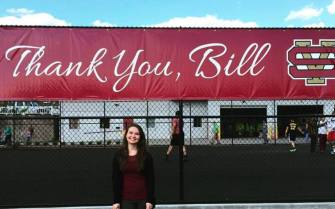
I had the honor of addressing Steel Valley’s 2017 Seniors to kick-off commencement season. The following speech was delivered at the Lawrence A. Griffin Senior Honors Banquet on May 4, 2017.
Thank you, Mr. Wehrer, for that kind introduction.
Board members, faculty, staff, guests, parents, families, and most importantly, seniors- good evening, and congratulations to the members of the graduating Class of 2017.
My name is Katie Bennett, and I know that Mr. Wehrer touched on my experiences but for those of you who don’t know me, I’d like to tell you just a little bit about myself- I am currently pursuing my master’s degree in higher education management from the University of Pittsburgh, where I also serve as a graduate assistant in the School of Education’s Office of Career and Student Services. Previously, I spent nearly three years working at a global public relations firm in New York City, and before that, I graduated Summa Cum Laude from Duquesne University with degrees in English Literature and Public Relations.
Before I was any of those things, though, my life looked very similar to many of yours. Just seven years ago, I was the salutatorian of Steel Valley’s graduating class of 2010, and the recipient of the William V. Campbell family endowed scholarship. I had spent five years in the color guard, four years in the drama club, and participated in a variety of student organizations like the French Club, History Club, and SADD. In the classroom, I too had to write in-class essays on Long Day’s Journey into Night for Mr. Altman, and study long hours for the Pitt exams in Mr. Vickers’ calc class.
As you can see, in a lot of ways, nothing changes in the seven years after you leave Steel Valley. But in a lot of very important ways, everything changes. You will be several different people between 2017 and 2024. I’d like to tell you about some of the people I’ve been, and three of the most significant lessons I’ve learned.
Let’s begin with a story about the person I was who most closely resembles many of you. When I was admitted to Duquesne, it was as a biology/pre-med student. To be completely transparent, I have never had any particular affinity for science or medicine. Rather, one day someone offhandedly mentioned they thought I would make a good doctor, and the idea resonated. I had good science and math grades (not as high as my English and Social Studies grades, but still As), I thought learning about how human beings work was interesting, and probably most importantly at the time, I liked the way “DR. KATIE BENNETT” sounded.
So, on little more than a suggestion from someone I don’t even remember, I began to plan my life after high school. Of course, doctor was not the first profession I had ever considered. It wasn’t even the first medical profession I’d ever considered- that was biomedical engineering. Completely unrelated, the first serious career I had ever considered as a seventh grader was, I kid you not, a foreign correspondent for a newspaper like The New York Times. I always had wide-ranging interests in a variety of subjects, and this only intensified once I got to Duquesne and began to encounter all of the other occupations I hadn’t even begun to consider.
Only two weeks into my first semester, I changed my major to English lit after realizing that A) though I genuinely enjoyed biology, I could not picture a life that also included chemistry on a daily basis and B) though I had no idea how I would make money reading books and writing, I had to study my one true academic love. I later added public relations as a second major to serve as my practical, career-oriented trade, but given the time and an unlimited amount of funding, I would have also enjoyed studying psychology, Spanish, and even philosophy.
During my sophomore year of college, I began to feel a kind of anxiety about all the subjects I couldn’t feasibly study. In Economics, this is called an “opportunity cost,” or a benefit you could have received but gave up in order to pursue another course of action. You guys might be familiar with a concept called “FOMO,” or the fear of missing out. Same thing.
I’ve experienced this phenomenon twice since then- at the end of college when deciding if I should attempt a PhD in 18th Century British Romantic Poetry, (which, as you can imagine, is where the big bucks are), or if I should go straight into the workforce as a publicist. I’m also in the middle of experiencing it yet again, as I change to another career by obtaining my master’s degree in a new field altogether.
As all of you graduate from high school with honors and awards, I suppose this anxiety is something you might also be feeling. When you’re good at a lot of things and have an admirable work ethic, a variety of opportunities will become available to you in college and in your careers.
It might not make any sense, but sometimes it may feel overwhelming to have options- because then you’re very aware of all the things you’ll be giving up as you make your decisions.
And so in response to your FOMO and difficult decision making, my first life lesson is:
YOU CAN BE ANYTHING, BUT YOU DON’T HAVE TO BE EVERYTHING
By your very nature as a Steel Valley graduate, I know that you have a foundation that will allow you to succeed in any path you choose. Steel Valley football players can have undefeated seasons and win State Championships. Steel Valley actors can lose their director for several weeks and rally together to put on an incredible show. You’ll be able to do the same in your careers and personal lives- but you must not start out on your new journey by being devastated at the thought of all the things you will not get a chance to try.
J.K. Rowling once wrote, “My philosophy is that worrying means you suffer twice.”
It’s my hope that as you embark on the next chapter of your lives, you’ll be inspired by your options instead of overwhelmed by them- and as you say yes to exciting and memorable adventures, you’ll feel motivated by all that you do have the privilege to create.
In my experience, making decisions is often only the beginning of a battle. (I know you’re probably all thinking- ‘does this girl ever actually do anything or is it mostly just sitting around all day surrounded by pro and con lists? Let’s just say with all the rationalizing I can do, I’ll consider being a lawyer as my third career if this whole higher ed-thing doesn’t pan out.)
In all seriousness, as you consider the practical consequences of your actions, it’s equally important to consider how those consequences are making you feel. This is something I did not do when I took my first job as a publicist in New York City.
For as long as I can remember, living and working in Manhattan was the quote/unquote “dream.” When I graduated from Duquesne, I was afraid to actually put my money where my mouth was and apply for jobs there- so I sent out no less than 60 applications in Pittsburgh, and only one in New York. And I got it. (A very important side note- I didn’t know anyone at the company and scored that job via my resume and qualifications alone- so yes, it can be done. Always let your accomplishments speak for themselves).
At 22 years old, I secured everything I ever wanted. Right job, right city, right timing. It was as though the universe had discovered my to-do list and carefully checked each box on my life plans. What we didn’t account for, the universe and I, was that wish fulfillment does not a happy life make. On paper, everything was perfect: from the Empire State building sunrises to the Hudson River sunsets. But I must admit that I knew something was amiss from the very origins of my star-crossed New York love story. The job, the apartment, the friends: a tender whisper of conscience chanting with every steady heartbeat This. Is. Fine.
But I didn’t want fine. I have never wanted fine. I have never settled for anything less than magic. That was my first and perhaps only mistake: refusing to listen to my intuition, the compass that had yet to lead me astray.
And so, my second life lesson-
TRUST YOURSELF
I now find it funny that this piece of advice was written to me explicitly right before I graduated from Duquesne- in the form of a dedication one of my professors inscribed in a copy of The Rime of the Ancient Mariner that he had chosen just for me.
I was the girl who had changed her major because after just two weeks, biology no longer felt right. I had those same feelings about my job- not because of the company or the work, but because of who I was. I couldn’t make a living cold calling reporters, asking them to write about accounting firms. As you know, I was living under the weight of the lives I had consciously given up in order to pursue this one. And I couldn’t waste my time on a path that was comparatively only mediocre at best. It’s true, what Stephen Sondheim wrote in his musical Anyone Can Whistle– once you see, you can’t stay blind.
I do not regret the three years I spent in Manhattan- how can I, when it was all I’d ever wanted? When it revealed to me the next step to take, which is turning out to not only be a career- but the active practice of my passion day in and day out?
I have learned that you will have lots of dreams in your life- and that often, through hard work and persistence, they will come true. When you hear a voice within yourself imploring you to begin again- listen to it. Weigh your options, and make an informed decision. And most importantly, say yes to yourself. It’s the bravest, most honest way to live an authentic and happy life.
And so finally- there is but one other tiny lesson that I hope you’ll find useful as you start your next chapter.
For every person I have been, my main motivation has been perfection. Perfect grades. Perfect family life. Perfect career.
I hope I am not the first to tell you that trying to be perfect is foolish nonsense. Chasing an impossible ideal will tarnish every success you have with the question “could I have been better?”
Even if the answer to that question is yes, there are far more important things to seek than perfection. Which leads me to my third lesson-
NOT PERFECT, BUT GOOD
There is no such thing as a perfect life. Of course, there are goals that you’ll want to achieve and experiences you’ll want to have. But you must know that in life, you will be surprised by things and people that don’t fit into your description of the ideal. And you’ll drive yourself mad by only allowing yourself to feel happiness and pride at those things that fit within these boundaries. Your life does not have to be perfect to be good.
For a very long time, I had a job where I could not see the purpose of my hard work. But because it fulfilled this vision I had of what my perfect life could look like, I sucked it up and continued to do it. I now know what it is like to find a job that feels like not a career, but a calling. It’s no longer about the perfection of my own life, but what I can do to make the lives of others more perfect.
On your journeys, I hope that you find work that is meaningful to you. Take the skills that you have begun to cultivate here, and make contributions to something that you value. If, instead of perfection, you work towards solving problems for others and making the world a little better than it was when you got here, you will often find fulfillment in the places you never expected. This is what makes you both a living, and a life.
John Steinbeck wrote in East of Eden, “And now that you don’t have to be perfect, you can be good.”
I wish you all the luck in the world throughout your lifelong pursuit of good.
Thank you.
 Katie Bennett Writes